
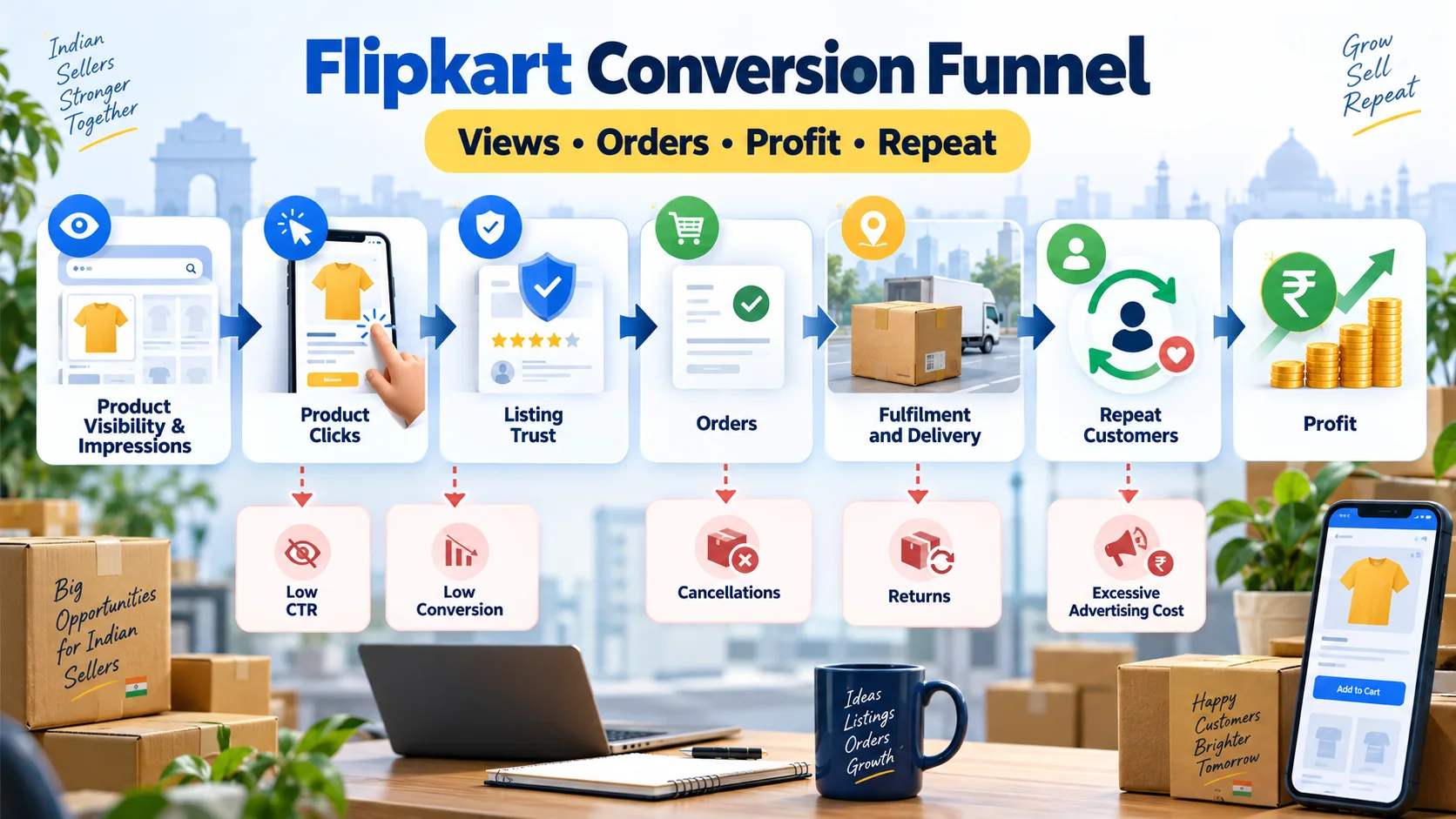
How to Reduce Returns and RTO on Meesho, Flipkart and Online Stores
Diagnose customer returns and failed deliveries separately, improve listings and packing, and measure the real cost of each returned order.
Returns and RTO can make a growing online business lose money even when its order count looks healthy. The first improvement is to separate products returned after delivery from parcels that never complete delivery. The causes, customer experience and costs are different, so one blanket “return problem” metric often leads to the wrong solution.
Customer returns follow a delivery and may involve fit, damage, missing items, defects or a mismatch between the listing and the product. Return to origin, or RTO, generally means a parcel comes back without successful delivery. Examples include refusal, unsuccessful delivery attempts or address-related issues. Confirm the exact status definitions in your platform reports.
Build a reliable baseline before changing anything
Export order-level data for a dispatch cohort and allow enough time for delivery and the relevant return window. A batch dispatched yesterday cannot be fairly compared with one whose returns have finished. Track order item ID, SKU, variant, dispatch date, delivery outcome, return reason, parcel condition and net loss.
| Metric | Suggested definition | Decision it supports |
|---|---|---|
| Customer return rate | Returned delivered items divided by delivered items in the cohort | Product and expectation problems |
| RTO rate | Undelivered items returned to origin divided by dispatched items | Delivery and acceptance problems |
| Damage rate | Damaged items divided by inspected items, with inspection stage recorded | Quality and packing controls |
| Retained-order contribution | Contribution after allocating net failed-order losses | Whether continued sales are worthwhile |
Keep denominators and observation windows stable. Report counts beside percentages: two returns out of five deliveries is a very different evidence base from two hundred out of five hundred. Segment by SKU, variant, supplier batch and dispatch location before drawing conclusions.
Fix listing mismatch before buying more traffic
Compare the actual returned sample with every customer-facing promise. Check measurements, pack quantity, colour, material, accessories and compatibility. A “set” title without a clear included-items list can create avoidable disappointment. Photographs should represent the product supplied, not a better sample or an unrelated supplier image.
- Publish measured dimensions and specify the measurement method.
- For clothing, explain whether the chart uses body or garment measurements.
- List exactly what is included and what is shown only for demonstration.
- Show useful close-ups of texture, fasteners and connectors.
- Replace vague “premium” claims with verifiable specifications.
- Check that every selectable variant matches its image and description.
Use a packing and picking checklist
Before sealing a parcel, confirm the order item, SKU, size, colour, quantity and visible condition. Protect the product against the realistic journey: compression, movement, handling and moisture exposure. Test the final package rather than assuming thicker packaging always solves damage. Extra volume can increase shipping cost without improving protection.
Where the platform permits operational evidence, retain appropriate packing records for claims and training. Follow its privacy rules and evidence requirements. Packing records do not guarantee that a claim will be accepted. Train staff on the most common incorrect picks and use separate bins for visually similar variants.
Investigate RTO using actual delivery evidence
Review tracking events and the reason recorded by the platform or logistics partner. Distinguish address problems, delivery attempts, buyer refusal and dispatch delay. For your own store, request only the address information needed for delivery and offer an easy correction path before dispatch. For marketplace orders, use approved support and communication routes.
Do not export marketplace phone numbers into unsolicited promotional lists or move buyers off-platform to avoid policies. A delivery confirmation process should clarify an existing order, not pressure someone into accepting it. Check the platform's allowed tools before contacting customers directly.
Match the action to the cause
| Repeated reason | First investigation | Practical change |
|---|---|---|
| Size or fit mismatch | Actual measurements versus chart | Correct the chart and isolate inconsistent batches |
| Wrong item or quantity | Picking records and bin organisation | Add variant and quantity checks |
| Damage | Pre-dispatch condition and package movement | Improve protection and supplier quality |
| Not as described | Photos, specification and included items | Replace ambiguous promises |
| Late delivery or refusal | Dispatch timing and tracking history | Improve stock readiness and investigate delivery events |
| Unclear reason | Return inspection and available feedback | Record evidence before assuming customer intent |
Calculate the loss on a returned parcel
Net return loss = unrecovered fulfilment costs + reverse and handling costs + product value lost − recoveries or reimbursements. Include only applicable charges and avoid subtracting the refund twice. A saleable item returned to stock is different from a destroyed item. Record inspection, repacking and time spent separately if they materially affect the decision.
Illustrative example: a returned item incurs INR 60 unrecovered forward costs, INR 50 reverse charges and INR 15 handling, while losing INR 30 of stock value. With no reimbursement, net loss is INR 155. These are hypothetical inputs, not a platform tariff. Actual loss depends on the reason, fulfilment arrangement and settlement adjustments.
Meesho's public pricing page describes different treatment for RTO return shipping. Do not apply that statement to every customer return or assume it removes all costs of an undelivered order. Verify current terms and the actual settlement. Flipkart's official documentation also separates customer and courier returns.
A 30-day improvement plan
- Week 1: choose a matured baseline cohort and identify the largest loss-making SKU or variant.
- Week 2: inspect samples and change the most likely listing, quality or packing cause.
- Week 3: monitor comparable new orders, stock accuracy and customer feedback.
- Week 4: review early outcomes and schedule a final comparison after the new cohort matures.
Change one major cause at a time where practical and record the date. Do not declare victory from a lower return percentage if delivery volume collapsed. Judge retained orders, contribution and customer complaints together. Pause a defective SKU while fixing the defect instead of using discounts to sell through it.
Related guides
Use our seller cost comparison to put return loss into pricing, and the supplier verification guide to prevent repeat quality problems. The goal is fewer avoidable failures while maintaining honest listings and fair customer support.
Sources and verification
Official resources reviewed on 4 October 2026. Platform features and terms can change; confirm current account-specific details before acting.
- Meesho official return and RTO pricing overview
- Flipkart official customer-return and courier-return definitions
- Flipkart official fulfilment and packaging responsibilities
Product shortlists, worksheets and operating checklists are AFShop editorial frameworks. Numerical examples are hypothetical; no search-volume, bestseller or earnings guarantees are claimed.
Found an error? Review our Corrections Policy or contact the editorial team.
Article at a glance
| Written by | Aarav Sharma |
|---|---|
| Published | 04 Oct 2026, 12:49 PM IST |
| Reading time | 5 minutes |
| Topic | Ecommerce research and practical guidance |
Frequently Asked Questions
What is the difference between a return and RTO?
A customer return follows delivery. RTO generally means a parcel returns without successful delivery. Use the exact definitions in your platform reports.
How do I calculate RTO rate?
For a consistent dispatch cohort, divide undelivered items returned to origin by dispatched items. Allow time for delivery outcomes and report counts beside the rate.
Can accurate product photos reduce returns?
Accurate photos can reduce expectation mismatch, especially when supported by measurements, material details and included-item descriptions. They cannot solve defects or every delivery problem.
Does RTO always have a reverse shipping charge?
Treatment varies by platform and current terms. Check the specific RTO rules and actual settlement instead of applying customer-return charges to every undelivered parcel.
Should I stop selling a high-return product?
Investigate the cause and contribution first. Pause products with unresolved defects or negative economics while improving quality, listing accuracy or packing.
Can I contact marketplace buyers to confirm orders?
Use only platform-approved communication and support tools. Follow privacy and marketplace policies and avoid unsolicited marketing or off-platform diversion.

Aarav Sharma
Ecommerce Research WriterAarav writes practical ecommerce research guides for AFShop, focusing on online shopping behaviour, product discovery, pricing signals and consumer decision-making in India.
View author profileRead More Blogs

Amazon Seller Registration 2026: Amazon पर सामान कैसे बेचें? Complete Hindi Guide
Amazon seller account registration, GST, documents, product listing, fulfilment, fees, pricing, first orders, returns और profit calculation की detailed Hindi guide।
4 · Read blog
Festive Sale 2026 Seller Playbook: Amazon, Flipkart और Meesho पर Profitable Sales कैसे बढ़ाएं?
Festive Sale 2026 के लिए inventory, pricing, discount, ads, listing, dispatch, returns और profit का practical seller playbook—Amazon, Flipkart और Meesho sellers के लिए।
3 · Read blog
Amazon Seller Fees और Profit Calculation: हर Order पर कितना Margin बचेगा?
Amazon पर referral fee, closing fee, shipping, FBA, ads और returns के बाद वास्तविक contribution कैसे निकालें? Practical cost sheet, examples और settlement checklist सहित guide।
5 · Read blog
Best Products to Sell on Meesho: 15 Ideas and a Practical Selection Guide
Compare 15 product ideas for Meesho using demand signals, supplier quality, shipping weight, return risk and realistic profit before buying stock.
3 · Read blog
Comments 0
No comments yet. Be the first to share a useful thought.
Leave a comment
Your email address will not be published. Comments are reviewed before appearing. Web addresses are displayed as plain text and are never clickable.